



 ₹https://preschool.littlemillennium.com/little-millennium/preschool-in-gurdaspur/preschool-in-fatehgarh-churian/little-millennium-preschool-in-fatehgarh-churian-gurdaspur--5xyXf1/articles/building-emotional-intelligence-in-preschoolers-a---984acd36-41d3-4816-b7b3-e762ab7c343f
Little Millennium Preschool, Fatehgarh Churian, gurdaspur
Preschool Pre School in Fatehgarh Churian, Gurdaspur, Punjab
Randhawa Market, Nearby Old Bus Stand, Fatehgarh Churian, gurdaspur, punjab - 143602
Request A Call Back
Little Millennium Preschool Social Feeds in Fatehgarh Churian, gurdaspur
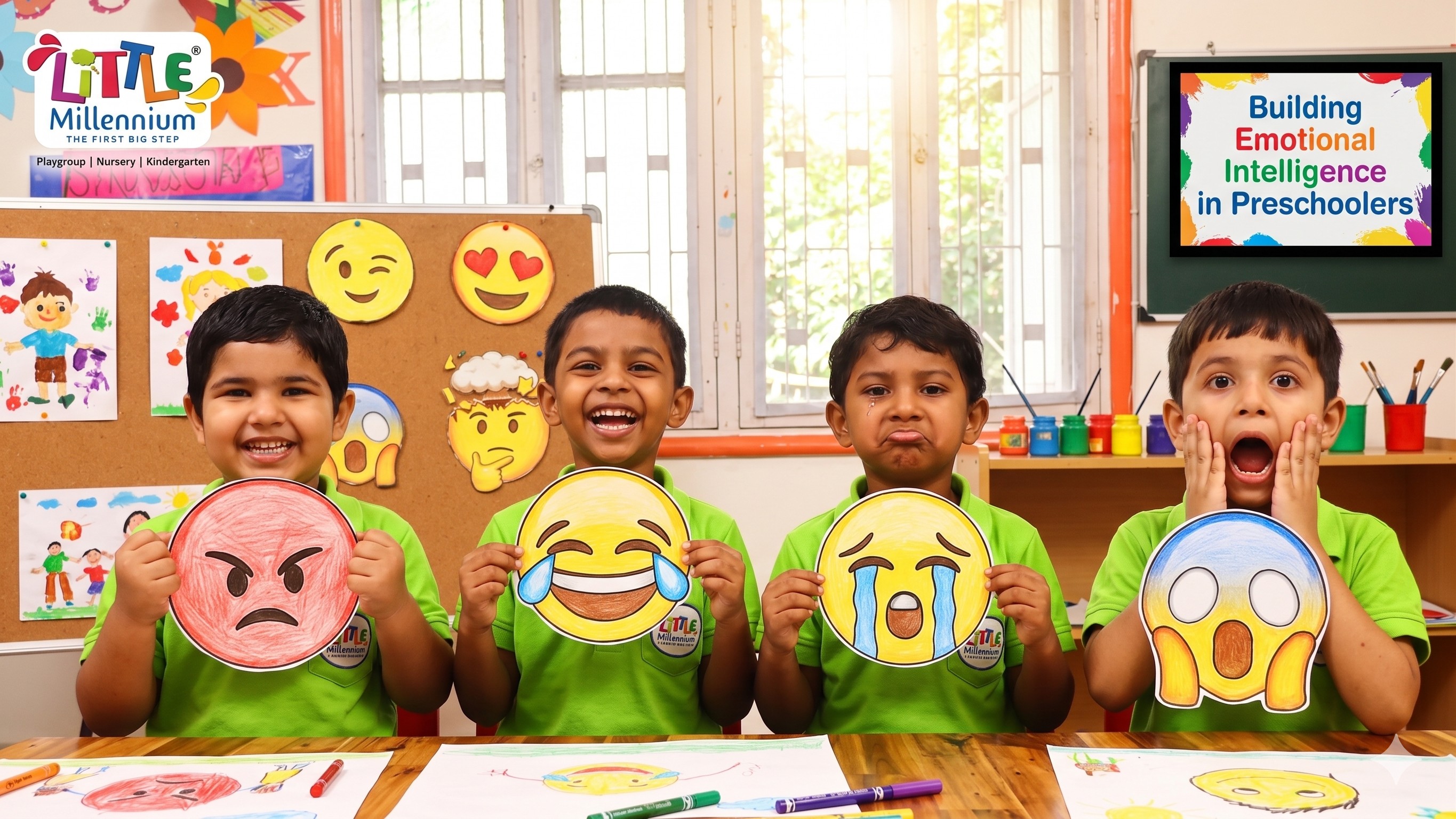
Building Emotional Intelligence in Preschoolers: A Guide for Parents in Fatehgarh Churian, gurdaspur
Learn how preschools and parents in Fatehgarh Churian, gurdaspur can
nurture emotional intelligence in young children, helping them build empathy,
resilience, and confidence from an early age.
In recent years, parents and educators alike have begun recognising that
academic skills are only one part of a child's success. Equally important — and
increasingly emphasised — is emotional intelligence, often referred to as EQ.
For families exploring the best preschools, understanding how early learning
environments support emotional development can be just as valuable as
evaluating curriculum and infrastructure.
Emotional intelligence helps children recognise their own
feelings, understand others, manage challenges, and build healthy
relationships. These skills lay the foundation for resilience, empathy, and
confidence in later life.
What Is Emotional Intelligence in Early Childhood?
Emotional intelligence refers to a child's ability to
identify, express, and manage emotions appropriately. In preschool years, this
includes recognising basic feelings like happiness, sadness, anger, and fear —
and learning how to respond to them in healthy ways.
It also involves understanding that other people have
feelings too — the beginning of empathy. A child who can say "My friend is
sad, I will share my toy" is demonstrating an early form of emotional
intelligence.
While EQ develops naturally over time, the experiences
children have during their preschool years play a significant role in shaping
it.
How Preschools Support Emotional Development
A nurturing preschool environment offers many opportunities
for children to practise emotional skills in real-life situations. Group
activities, shared play, storytelling, and circle time all encourage children
to express themselves and listen to others.
Teachers play a vital role by modelling calm responses,
naming emotions out loud, and guiding children through small conflicts. For
example, when two children want the same toy, a skilled teacher helps them
recognise their feelings, take turns, and find solutions — turning everyday
moments into valuable learning experiences.
Little Millennium Preschools incorporate emotional learning
into their curriculum through stories, songs, role-play, and reflection
activities that build awareness in age-appropriate ways.
Everyday Ways Parents Can Build EQ at Home
Parents are a child's first and most influential emotional
teachers. Simple, consistent practices at home can powerfully reinforce what
children learn at preschool.
Naming emotions throughout the day helps children build a
vocabulary for their feelings. Phrases like "You seem frustrated because
the blocks fell" or "I can see you are excited about the visit"
help children make sense of their inner experiences.
Listening attentively when a child speaks — without rushing
to fix or dismiss feelings — teaches that emotions are valid and worth
expressing. Reading storybooks featuring characters who face emotional
situations also opens space for meaningful conversations.
Encourage Problem-Solving Over Avoidance
When children encounter small frustrations — a puzzle they
cannot solve, a toy they cannot share — parents can guide them through gentle
problem-solving rather than stepping in immediately. Questions like "What
do you think we could try?" help children develop confidence in handling
challenges.
Over time, these small experiences build resilience and
self-regulation, which are core components of emotional intelligence.
Help Children Understand Others' Feelings
Empathy is a skill that grows through observation,
conversation, and example. Parents can encourage empathy by pointing out how
others may feel in different situations.
When a friend falls and cries, instead of simply saying
"It's okay," parents can say "He seems hurt. How can we help him
feel better?" These small prompts help children move from focusing only on
themselves to noticing and caring about others.
Emotionally intelligent children grow up to be more
cooperative, more understanding, and more capable of building healthy
friendships.
Why Emotional Intelligence Matters for Lifelong Learning
Children with strong emotional skills tend to adjust better
to school, manage stress more effectively, and form positive relationships with
peers and teachers. They are also better equipped to focus, follow
instructions, and engage in classroom learning.
In a fast-paced world, emotional intelligence has become one
of the most valuable life skills — supporting not only academic achievement but
also long-term well-being and success.
Final Thoughts
Emotional intelligence is not something children learn from
textbooks—it develops through everyday interactions, meaningful relationships,
and thoughtful guidance. For parents in Fatehgarh Churian, gurdaspur, choosing a
preschool that prioritizes emotional well-being alongside academic growth helps
build a strong foundation for lifelong success, healthy relationships, and
overall happiness.
When children learn to recognize and manage their emotions,
understand others’ feelings, and respond with empathy, they grow into
confident, resilient individuals who are better prepared to navigate the world
around them. These early emotional skills become the cornerstone of both
personal and academic success.