


 ₹https://preschool.littlemillennium.com/little-millennium/preschool-in-gurdaspur/preschool-in-fatehgarh-churian/little-millennium-preschool-in-fatehgarh-churian-gurdaspur--5xyXf1/articles/the-power-of-pretend-play-why-imagination-matters---e949f3c6-3b11-41f7-ad91-3d96633dc5d4
Little Millennium Preschool, Fatehgarh Churian, gurdaspur
Preschool Pre School in Fatehgarh Churian, Gurdaspur, Punjab
Randhawa Market, Nearby Old Bus Stand, Fatehgarh Churian, gurdaspur, punjab - 143602
Request A Call Back
Little Millennium Preschool Social Feeds in Fatehgarh Churian, gurdaspur
The Power of Pretend Play: Why Imagination Matters at Preschools in Fatehgarh Churian, gurdaspur
Explore how pretend play and imagination at preschools in
Fatehgarh Churian, gurdaspur build language, social skills, problem-solving, and
creativity in young learners.
Watch a child turn a cardboard box into a spaceship or a wooden spoon into a
magic wand, and you witness one of the most powerful tools of early learning in
action — pretend play. For parents exploring quality preschools, understanding
the role of imagination in early childhood development offers fresh insight
into what truly meaningful learning looks like.
Pretend play, also known as imaginative or make-believe
play, is far more than entertainment. It is a sophisticated cognitive activity
that shapes how children think, communicate, and understand the world around
them.
What Happens During Pretend Play
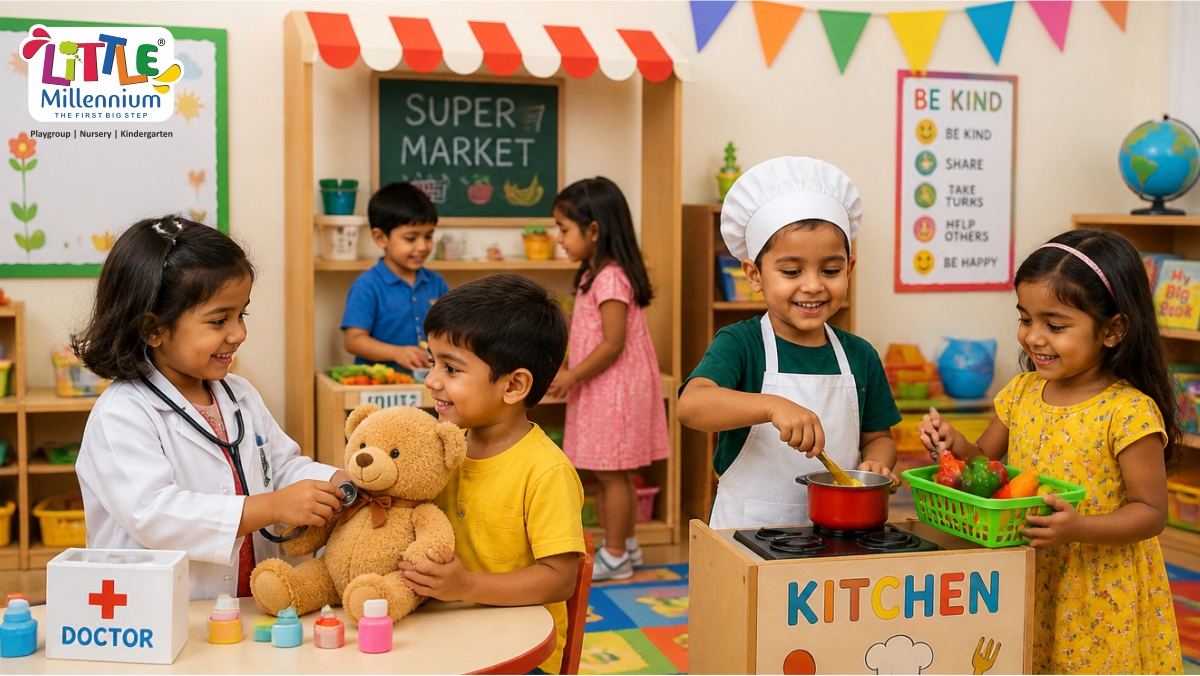
In pretend play, children take on roles, create scenarios,
and use objects symbolically. A young child may pretend to cook a meal, run a
small shop, care for a doll, or act out scenes inspired by everyday life.
While it may look like simple fun, this kind of play
involves complex mental processes — planning, sequencing, language use,
problem-solving, and social negotiation. Children make decisions, follow
self-created rules, and adapt as situations evolve.
This is why educators around the world consider pretend play
a cornerstone of early childhood learning.
Building Language and Communication Skills
Pretend play is a naturally language-rich activity. Children
narrate their actions, give voices to characters, and engage in conversations
with playmates. This continuous use of language helps expand vocabulary,
sentence structures, and storytelling abilities.
When children play together, they negotiate roles, share
ideas, and resolve small disagreements. These interactions strengthen
communication skills in ways that structured lessons alone cannot match.
Preschools that include dedicated time for imaginative play
create an environment where language development happens organically and
joyfully.
Developing Social and Emotional Skills
Pretend play often involves social interaction, especially
when children play in groups. They take turns, share materials, and learn to
consider others' ideas. They also explore emotions safely — playing roles such
as parents, doctors, shopkeepers, or characters from stories.
This role-play allows children to understand different
perspectives. A child pretending to be a doctor caring for a patient is
practising empathy. A child taking turns to be the "teacher" is
learning leadership and listening skills.
Such experiences are essential for emotional development and
lay the groundwork for healthy relationships in later life.
Strengthening Cognitive and Problem-Solving Abilities
Imaginative play stretches a child's thinking. When a stick
becomes a sword, a chair becomes a bus, or a blanket becomes a tent, children
are engaging in symbolic thinking — an important step in cognitive development
that supports literacy, mathematics, and abstract reasoning later on.
Pretend scenarios also involve planning and sequencing. A
child setting up a pretend tea party must gather "ingredients,"
arrange seats, invite guests, and follow a series of actions. These small steps
build executive functioning skills that support classroom learning.
Boosting Creativity and Confidence
When children invent stories and characters, they exercise
creativity in its purest form. There are no right or wrong answers — only ideas
waiting to be explored. This freedom helps children develop original thinking
and the confidence to express themselves.
Confidence grown through imaginative play often carries into
other areas of learning. Children who feel free to invent and explore tend to
approach new challenges with curiosity rather than hesitation.
How Preschools Encourage Imaginative Play
Quality preschools intentionally create spaces for pretend
play. Role-play corners, dress-up areas, story enactment, dolls, kitchen sets,
and open-ended materials like blocks all invite children to imagine and create.
At Little Millennium, the BLOOM Curriculum integrates
imaginative experiences across daily activities, helping children develop
creativity, language, and social skills in a balanced, nurturing environment.
Supporting Pretend Play at Home
Parents can easily encourage imaginative play at home.
Simple props — a few costumes, household items, soft toys, or recycled boxes —
are often enough to spark hours of creative engagement.
Joining in occasionally, asking open-ended questions like
"What happens next?", and resisting the urge to direct the play helps
children take the lead in their own learning.
Limiting screen time and protecting unstructured play time
also gives children the mental space to imagine freely.
Final Thoughts
Imagination is one of the most valuable gifts of early
childhood. For families in Fatehgarh Churian, gurdaspur, choosing a preschool that
nurtures pretend play means giving children far more than entertainment — it
means supporting the cognitive, social, emotional, and creative foundations of
lifelong learning.
When children are free to imagine, explore, and create, they
grow into confident, curious, and capable learners ready to embrace the world
ahead.